
VivaTech 2025 > Lessons Learned
By Markus Schuller, CEO/Founder of Panthera Solutions
Monaco, June, 17, 2025.
I have just returned from VivaTech 2025 in Paris — here are a few takeaways
Over the years, I’ve attended several of the nine VivaTech editions. What began as a regional gathering has grown into Europe’s most prominent tech conference, thanks in large part to the sustained commitment of the French tech and corporate ecosystem—underpinned by the political backing of Emmanuel Macron. Its global relevance continues to expand.
- 180,000 visitors
- 14.000 start-ups and scale-ups
- 3,600 professional investors and capital funds
- 50 national pavilions
- 171 nationalities
AI as the Overarching Theme
Unsurprisingly, Artificial Intelligence dominated the agenda—more precisely, Agentic AI, including both single-agent and multi-agent systems. While the theme itself offered little novelty, what stood out was the shifting tone of the event. VivaTech felt less like a gathering of nerds and more like a forum for applied innovation. The crowd was noticeably more senior, more managerial, more corporate—suggesting a maturing ecosystem, transitioning from experimental phase toward commercialization.
The King Is Naked
We’ve long voiced concerns that AI has overpromised and underdelivered, constrained by the conceptual limitations of transformer architectures and the GPT models built around them. From that flawed starting point, business and revenue models have remained weak, failing to justify the scale of capital invested, especially across the increasingly commoditized software layers of AI. So far, the real beneficiaries have been hardware, data, and energy providers.
It’s therefore no surprise that a community in transition—still lacking viable business models—focused heavily at VivaTech on securing funding and landing first clients. With short runways and fragile independence, many seemed more intent on integration into corporate structures than pursuing a stand-alone path to scale.
A Case in Point: Mistral AI
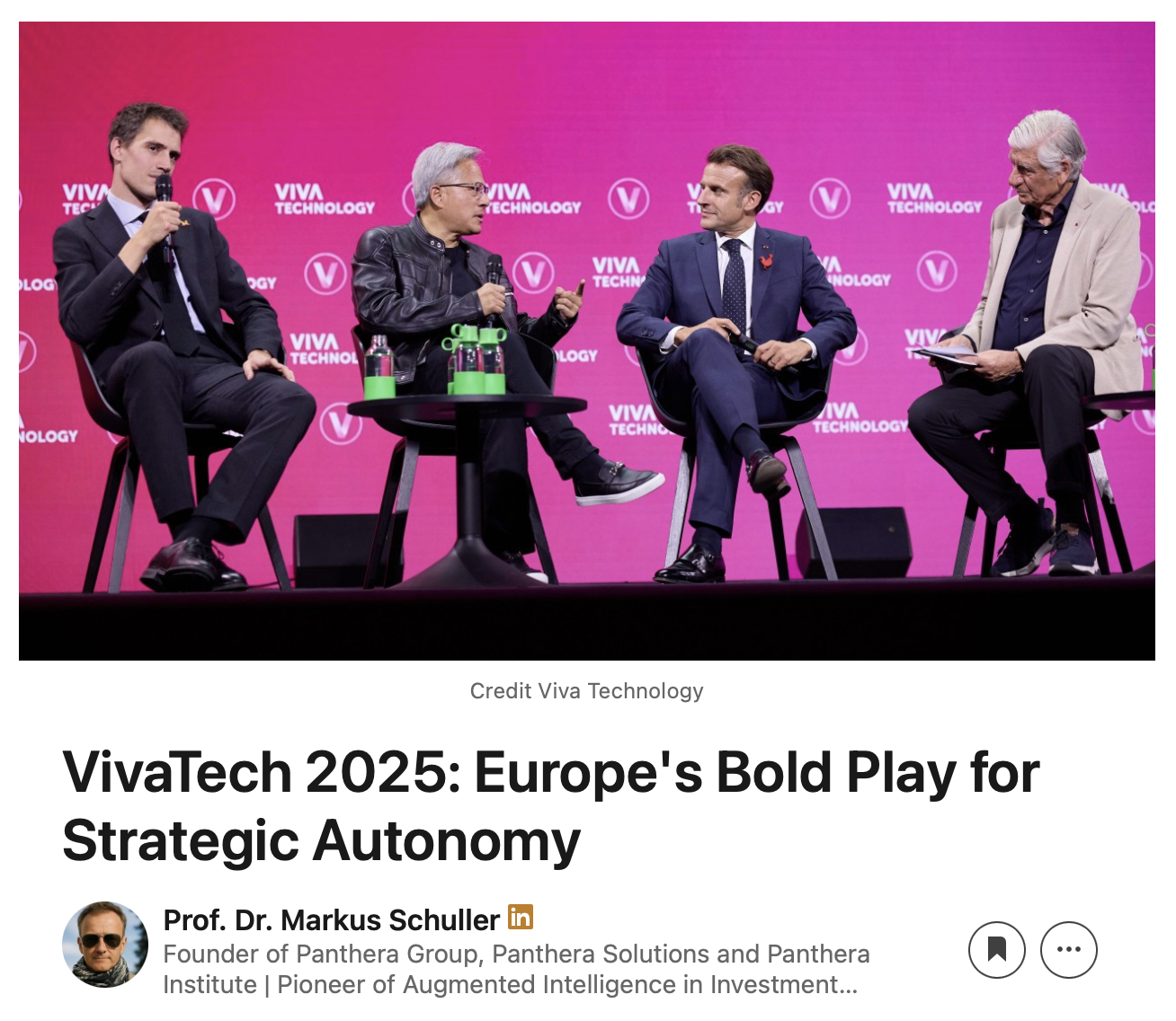
Arthur Mensch (CEO of Mistral AI) and Jensen Huang (Founder & CEO of NVIDIA) shared the main stage to announce their cooperation—an announcement that felt less like a commercial milestone and more like a public show of support. Mistral, still in search of a sustainable business model, clearly benefited from NVIDIA’s endorsement.
Jensen Huang is different to other big tech CEOs. It is visible how hardship and overcoming thereof acts as vivid reminder to stay humble and focused. Genuine and authentic. Impressive. Arthur Mensch appeared genuinely grateful, particularly as the NVIDIA partnership quickly unlocked interest from major French corporates for use cases.
In a telling moment, the moderator joked that the French president and the NVIDIA CEO were becoming Mistral’s best salespeople. The poster child of European GPTs, seeking validation and support from hardware giants and legacy industries— quod erat demonstrandum.
Europe Has What It Takes
Notably, U.S. Big Tech was largely absent from VivaTech 2025. Those present – Microsoft, Salesforce IBM, AWS and NVIDIA – are not known to be the classic Mar-a-Lago fan boys. Chinese tech players were similarly absent, whether by choice, geopolitical signal, or curatorial decision. In contrast, Canada was the official country of honor, fielding a delegation of over 170 tech and AI-focused organizations.
Regardless of the motivations behind these absences, this year’s VivaTech felt markedly more European than French, more globally inclusive yet less dominated by advanced economies. The presence of African, Oceanian, Ukrainian, and Lebanese pavilions underscored a shift: VivaTech is emerging not just as a European tech summit, but as a platform for strategic global integration—with Europe positioning itself at the centre. Times, they are changing.
Implications for European Strategic Autonomy
This evolving identity points towards a growing European ambition for strategic independence in tech. The changing tone was recently echoed by Daniel Keiper-Knorr (here) and Andreas Schwarzenbrunner (here) of Speedinvest, who noted a perceptible shift in sentiment in their domain: from the view of Europe as an ageing and fading power, toward a continent regaining confidence.
There is renewed political will across Europe to level the playing field, reduce bureaucratic friction, and align industrial, defense, and technology agendas—especially in strategically critical areas like deep tech and artificial intelligence. Europe is increasingly positioning itself not as a challenger to the U.S. or Chinese ecosystems, but as a coherent, values-driven actor in global innovation. While I share Daniel’s and Andreas’ assessment of Europe’s shifting sentiment, their particularly favorable view of venture capital’s role in this transformation can be challenged. What’s missing?
The Bottleneck Is Not Innovation
Innovation has never been Europe’s primary constraint—ask Catriona Marshall , Danae Kyriakopoulou, or Werner Wutscher. The bottleneck lies in scaling innovation commercially through deep, integrated financial markets – see Uli Grabenwarter, Gerd Gigerenzer et al. European strategic autonomy will stand or fall based on two critical factors:
- Market Depth Across Corporate Development Stages The Enrico Letta and Draghi reports have underscored this. The current efforts of the European Commission under the lead of Ekaterina Zaharieva are encouraging—such as the proposed European 28th regime (here), which would offer a unified regulatory framework as part of the EU’s Startup and Scale-Up Strategy. This would allow companies to operate under a single set of rules across the bloc, reducing fragmentation and regulatory arbitrage.
- Superior Investment Decision Quality at Scale Even if capital is available, it requires high quality capital allocation decisions at scale to develop an edge. We are facing an awareness gap on that matter, also due to a gap of available data on investment decision quality. An example. As the literature on VC investment selection quality demonstrates (here), venture investing often resembles sophisticated guessing more than a robust, evidence-based process. This lack of replicable, high-quality routines for evaluating and scaling early-stage companies is a fundamental constraint. Moreover, the data required to assess and improve decision quality is largely absent, making progress even more difficult.
This problem of lacking replicability of quality routines can be addressed like in the US with brute force capital allocation and old loyalty networks (see PayPal gang), or like in China with brute force public capital allocation and old party loyalty networks. A comparably inefficient approach. Europe has the opportunity to do better—not by copying brute-force models, but by using integrated capital markets and smart knowledge creation and management between innovators, policy makers and capital allocators, to professionalize and upgrade the quality of investment decision-making. Our work at Panthera Solutions on investment decision designs does contribute to the practical implementation thereof.
European strategic autonomy will ultimately depend not only on how much capital is deployed, but how wisely it is allocated.